A Royal City
The summit contains a royal enclosure and structures associated with Madagascar’s former monarchy. They help visitors understand how royal authority, architecture and ceremonial life were organised in the Central Highlands.
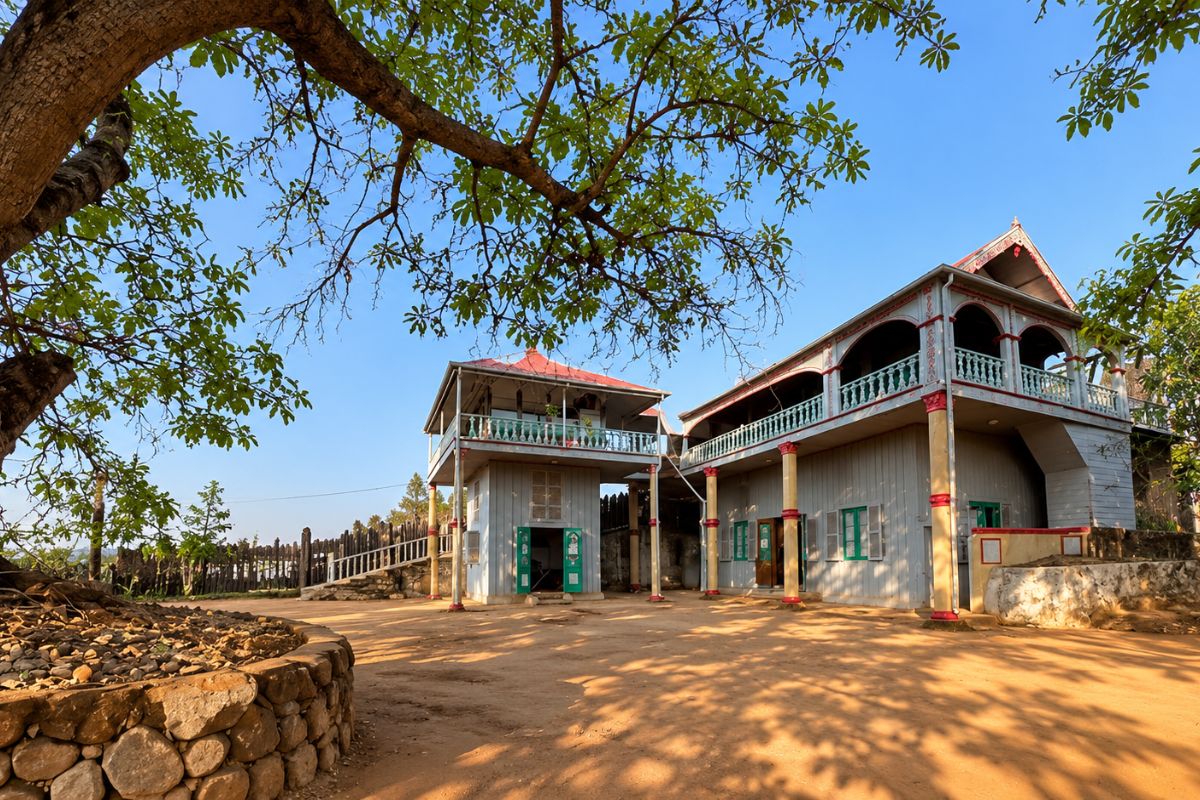
Ambohimanga, Madagascar is one of the most important cultural and historical places in the country. Rising above the Central Highlands near Antananarivo, the Royal Hill of Ambohimanga brings together royal history, traditional architecture, sacred places and landscapes that continue to hold deep meaning for many Malagasy people.
For travellers, Ambohimanga offers something very different from Madagascar’s lemurs, rainforests and beaches. This is a place to slow down, listen to the stories behind the landscape and understand how history, spirituality and Malagasy identity remain closely connected.
The Royal Hill of Ambohimanga has been inscribed on the UNESCO World Heritage List since 2001 and is one of the essential cultural places to consider when exploring Madagascar’s Central Highlands.
Many travellers arrive in Madagascar primarily for wildlife. That is understandable: lemurs, chameleons, baobabs and national parks are among the island’s greatest attractions. But visiting only natural sites means seeing only part of Madagascar.
Ambohimanga introduces another side of the country. The hill is closely linked to the history of the Merina monarchy and to the political development of the kingdom that played a major role in the formation of modern Madagascar.
More importantly, Ambohimanga should not be approached simply as an old palace or an archaeological monument. It is a cultural landscape where royal history, ancestor traditions, sacred places, architecture, forests and living beliefs remain connected.
That combination makes a visit particularly valuable at the beginning of a Madagascar journey. It gives cultural context to many traditions, landscapes and historical references you may encounter elsewhere in the country.
Ambohimanga is important not because of a single building, but because the entire hill forms a cultural and spiritual landscape.
The summit contains a royal enclosure and structures associated with Madagascar’s former monarchy. They help visitors understand how royal authority, architecture and ceremonial life were organised in the Central Highlands.
Sacred trees, water sources, ritual places and royal burial areas form part of the meaning of Ambohimanga. The landscape itself is inseparable from the site’s spiritual importance.
Ambohimanga is not simply a monument from the past. It continues to be respected as a sacred place and remains connected to pilgrimage, prayer and traditional beliefs.
To understand Ambohimanga, it helps to understand the role of Madagascar’s Central Highlands in the country’s political history.
Between roughly the fifteenth and nineteenth centuries, powerful political structures developed in the Highlands. The fortified hill settlements of the Imerina became centres of authority, defence and ritual life.
Ambohimanga became particularly significant as a royal centre associated with the dynasty that helped consolidate political power in the Highlands and later played a decisive role in the development of a more unified Malagasy state.
Its elevated position was important strategically. From the summit, the surrounding countryside could be observed, while fortifications helped protect the royal settlement.
But political power is only one part of the story. Royal authority in Madagascar was closely linked to ancestry, sacred geography and ritual. This is why the hill contains not only residences and defensive structures but also sacred places, burial areas, water features and trees associated with royal and spiritual life.
UNESCO describes Ambohimanga as an exceptional testimony to the civilisation that developed in Madagascar’s Central Highlands between the fifteenth and nineteenth centuries.
UNESCO recognises the Royal Hill of Ambohimanga for its exceptional importance to Malagasy cultural identity and for the way its traditional design reflects the social and political organisation of Malagasy society.
The site was inscribed on the World Heritage List in 2001 under criteria (iii), (iv) and (vi).
One of the most interesting aspects of Ambohimanga is the combination of physical heritage and living tradition.
Buildings, gateways, tombs and landscape features can be seen, but the significance of the site also comes from memory, ritual, ancestor traditions and continued spiritual use.
Authoritative source
Historical and UNESCO information on this page is based on documentation from the UNESCO World Heritage Centre. You can also consult the official UNESCO page for the Royal Hill of Ambohimanga.
The experience is less about rushing between individual monuments and more about understanding how the different parts of the royal hill fit together.
At the summit of the hill, the royal compound brings together structures associated with Madagascar’s former rulers. A guided explanation is especially valuable here because many architectural details have meanings that are not immediately obvious to visitors.
The surviving and restored royal structures illustrate different phases of Malagasy political history and reveal contrasts between traditional Malagasy building techniques and later architectural influences.
The hill formed part of a fortified royal landscape. UNESCO records a system of defensive ditches and fourteen fortified stone gateways, illustrating the strategic importance of the site.
Sacred water, trees, stones and ritual spaces help explain why Ambohimanga continues to be regarded as much more than a historic architectural site.
Royal burial places are central to Ambohimanga’s spiritual and historical significance. Visitors should approach these areas with particular respect and follow local guidance.
The elevated setting gives a broad perspective across the surrounding countryside and helps explain why the hill was selected as a strategic royal centre.
One of the most important things to understand before visiting is that Ambohimanga is a landscape, not just a collection of buildings.
Vegetation on the hill contributes directly to the atmosphere of Ambohimanga. UNESCO notes that the site contains important remnants of native forest as well as endemic and medicinal plants.
Trees and water are not merely decorative elements here. Some are associated with traditions and sacred meanings that form part of the cultural landscape.
The surrounding landscape of hills, cultivated land and settlements helps place Ambohimanga within the wider cultural geography of Madagascar’s Central Highlands.
Travelling through this region also reveals rice fields, traditional architecture and rural landscapes that differ greatly from the rainforest east, dry west and tropical coasts.
Ambohimanga is not a destination where the main attraction is a spectacular photograph or a single famous monument.
Its appeal comes from context.
Walking through the royal enclosure while hearing about the people who lived there, the meanings attached to particular spaces and the relationship between rulers and ancestors can transform what initially appears to be a quiet historic site into a much deeper introduction to Malagasy history.
Visitors who enjoy history, anthropology, architecture or cultural travel often appreciate Ambohimanga particularly strongly because it provides background that helps make sense of Madagascar beyond its wildlife.
It also provides a useful contrast to Antananarivo. The capital is busy, urban and energetic, while Ambohimanga offers a quieter environment in which to explore Madagascar’s royal and spiritual heritage.
Ambohimanga remains a culturally and spiritually significant place, so visiting respectfully is essential.
Some places may have particular customs or restrictions. Follow instructions from your guide or site staff, especially around sacred areas and burial places.
Photography rules can vary according to the location and circumstances. When people, rituals or sensitive cultural spaces are involved, asking first is the respectful approach.
Natura Travel tip
A cultural site becomes far more rewarding when you understand what you are looking at. Visiting with knowledgeable local interpretation allows architecture, traditions and sacred spaces to be understood in their historical and cultural context.
Ambohimanga is one of the most important destinations in Madagascar for travellers who want to understand the country’s royal and political history.
The relationship between living beliefs, architecture, ancestors and sacred landscapes provides insight that cannot be gained simply by visiting national parks.
Including Ambohimanga near the beginning of a journey can provide useful cultural context before travelling further through Madagascar.
Ambohimanga combines naturally with a stay in Antananarivo. Rather than treating the capital simply as an arrival or departure point, travellers interested in culture can use time in the Highlands to understand some of the country’s historical foundations.
Antananarivo introduces Madagascar’s contemporary capital, urban life and royal heritage, while Ambohimanga provides a quieter and more concentrated experience of sacred royal history.
Together, they provide a much richer introduction to the Central Highlands than simply passing through the capital on the way to a national park.
Ambohimanga can also be the first cultural stop in a longer journey south through Madagascar.
Continue south to a Highland city known for its distinctive atmosphere, surrounding rural landscapes and role on the classic RN7 route.
Discover an important centre of Malagasy craftsmanship surrounded by the green hills and agricultural landscapes of the Highlands.
Travel further south through the Highlands towards Fianarantsoa before continuing to rainforest, mountain and southern destinations.
A little planning helps you get much more from this cultural site.
Do not treat Ambohimanga as a quick photo stop. Allow enough time to walk through the site, listen to explanations and appreciate the relationship between the buildings, sacred places and landscape.
Yes, if possible. Much of Ambohimanga’s importance lies in meanings that are not obvious from architecture alone. Historical and cultural interpretation can make the visit significantly more rewarding.
Ambohimanga can be incorporated into a Central Highlands itinerary at different times of year. Weather and road conditions in Madagascar vary seasonally, so check the wider timing of your itinerary rather than choosing dates based on this site alone.
Practical arrangements, entrance fees and access conditions can change. We recommend confirming current information shortly before your visit rather than relying on an old travel guide or blog post.
Yes, particularly if you are interested in Malagasy history, culture, architecture or traditional beliefs. It offers a different perspective on Madagascar from the country’s better-known wildlife destinations.
Yes. The Royal Hill of Ambohimanga was inscribed on the UNESCO World Heritage List in 2001 for its cultural, historical and spiritual significance.
Ambohimanga is famous as a royal and sacred hill associated with the Merina monarchy, Malagasy cultural identity, royal traditions, sacred places and the history of the Central Highlands.
Yes. The two destinations complement each other particularly well. Antananarivo provides an introduction to the modern capital and its historical heritage, while Ambohimanga offers a quieter experience focused on royal history and sacred traditions.
A guide is strongly recommended if you want to understand the site’s historical and cultural significance. Many of its most interesting details are connected to traditions and meanings that are not obvious from the buildings alone.
No. One of the site’s defining features is that it remains culturally and spiritually significant. UNESCO describes it as a living place connected with ritual, pilgrimage, memory and traditional beliefs.
Depending on your itinerary, consider Antananarivo, Antsirabe, Ambositra and Fianarantsoa.
If you want to understand Madagascar beyond its wildlife, Ambohimanga is one of the most meaningful cultural additions to a journey through the Central Highlands. Natura Travel can include the Royal Hill in a private itinerary designed around your interests, available time and travel pace.