Watch the Sunset
Evening light is the classic Avenue experience,
illuminating the trunks while the sky changes colour behind the trees.
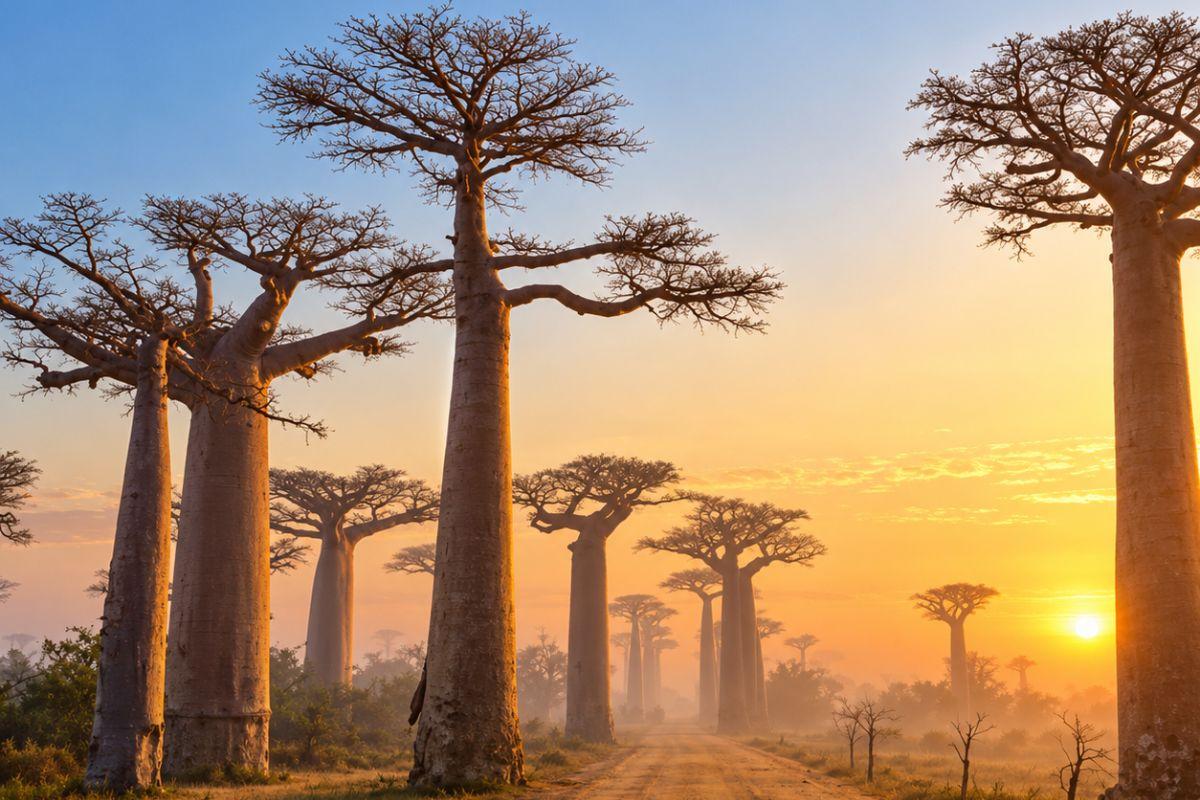
Known locally through the powerful image of the Renala, or “mother of the forest”,
these giant trees have become a symbol of the Menabe region and of Madagascar itself.
The Avenue is especially famous at sunrise and sunset, when warm light transforms
the trunks and silhouettes of the baobabs against an open western sky.
It is one of the essential stops on a journey through
Western Madagascar
and combines naturally with
Morondava
,
Kirindy Reserve
and
Tsingy de Bemaraha
.
Few landscapes in Madagascar are as immediately recognisable as the Avenue of the Baobabs.
Massive trunks rise almost vertically from the plains before opening into compact crowns
high above the road. Their unusual silhouettes become especially dramatic when seen
against the changing colours of sunrise or sunset.
The experience is simple: there is no complicated trekking route and no need
for a long wildlife search. Instead, the attraction is the landscape itself,
the extraordinary scale of the trees and the atmosphere created by light,
dust, people and everyday traffic passing between them.
It is also an excellent introduction to the dry ecosystems of western Madagascar
before continuing towards Kirindy and the Tsingy de Bemaraha.
Madagascar’s National Tourism Board regularly presents Morondava through
the image of the famous Avenue of the Baobabs.
Recent official tourism itineraries combine the Avenue with Kirindy Forest
and the nearby “Baobabs in Love”, making the route one of the signature
experiences of western Madagascar.
The Avenue lies along the road north of Morondava towards the landscapes
of the wider Menabe region.
Sources & Local Context
The relationship between Morondava, Kirindy and the Avenue of the Baobabs
is supported by recent itineraries published by Madagascar’s National Tourism Board.
The trees lining the Avenue belong primarily to one of Madagascar’s
most distinctive endemic baobab species.
The Avenue is dominated by Grandidier’s baobab
(Adansonia grandidieri), a species endemic to western Madagascar.
Mature trees develop enormous cylindrical trunks and can reach
impressive heights above the surrounding plains.
Baobabs are adapted to environments with a pronounced dry season.
Their thick trunks allow them to cope with long periods when water is limited.
Their leaves are seasonal, so the appearance of the Avenue changes
through the year.
The Avenue of the Baobabs is powerful partly because of the openness
of the surrounding landscape.
The huge trees appear isolated above fields and low vegetation,
making their scale immediately visible from a distance.
This open landscape also tells a wider environmental story.
Baobabs that once formed part of more extensive vegetation now stand
prominently within a landscape shaped by generations of human use.
Visiting the Avenue therefore offers both a spectacular view
and an opportunity to think about conservation in western Madagascar.
Evening light is the classic Avenue experience,
illuminating the trunks while the sky changes colour behind the trees.
Early morning provides softer light, cooler temperatures
and a very different atmosphere from the busier sunset period.
Use the road, people and passing carts as elements that help show
the extraordinary scale of the baobabs.
Nearby intertwined baobabs are commonly included in excursions
between Kirindy and Morondava.
Continue north into dry deciduous forest known for lemurs,
reptiles, birds and the fossa.
Use Morondava as the starting point for a wider route through
baobabs, dry forest, rivers and limestone landscapes.
Sunset is the most famous time to experience the Avenue.
Recent itineraries from Madagascar’s National Tourism Board specifically
highlight the multicoloured landscape created around the giant trees
as the sun goes down.
The trunks take on warmer tones while their crowns become silhouettes
against the western sky.
This is also usually the busiest period, so travellers interested
in photography should allow time to explore several viewpoints rather
than expecting an empty road.
Most travellers choose sunset, but sunrise offers a completely different mood.
Early morning light can create softer colours and long shadows,
while the site may feel quieter before the day’s traffic increases.
Photographers with enough time may therefore want to visit twice:
once in the evening and again the following morning.
Give yourself time to walk along the area and choose
compositions before sunrise or sunset begins.
Pedestrians, bicycles, carts and vehicles can help communicate
just how enormous the baobabs really are.
The Avenue remains part of a living local landscape.
Do not block residents, vehicles or carts simply to create a photograph.
Morondava is the main tourism base for the Avenue of the Baobabs
and the wider Menabe region.
Staying in Morondava makes it possible to combine the Avenue
with Kirindy, coastal excursions and longer journeys north.
The route towards the Avenue and destinations farther north
can be affected by seasonal conditions.
Current road access and transfer times should therefore
be confirmed when planning the journey.
One of the strongest western Madagascar experiences is to combine
the Avenue of the Baobabs with Kirindy.
Recent Madagascar National Tourism Board itineraries travel from Morondava
to Kirindy, include wildlife excursions in the dry forest,
and then stop at the Baobabs in Love and the Avenue on the return journey.
This creates a much richer day than visiting the Avenue alone:
wildlife and forest exploration during the day,
followed by one of Madagascar’s great sunset landscapes.
The Avenue also fits naturally into a longer expedition
through western Madagascar.
Travellers continuing north can move from the open baobab landscapes
of Menabe towards the extraordinary limestone formations
of Tsingy de Bemaraha.
The contrast between the two environments is one of the strongest
features of a western Madagascar itinerary.
Reaching Tsingy de Bemaraha involves significant overland travel
and seasonal road considerations.
It should therefore be planned as a multi-day western journey
rather than as a quick excursion from Morondava.
No. The Avenue of the Baobabs is not currently inscribed
on the UNESCO World Heritage List.
It also does not appear on Madagascar’s current UNESCO Tentative List.
UNESCO currently lists three World Heritage properties in Madagascar:
the Royal Hill of Ambohimanga, the Rainforests of the Atsinanana
and the Andrefana Dry Forests.
The Avenue should therefore be described for what it genuinely is:
an exceptional protected baobab landscape and one of the most recognisable
natural landmarks in western Madagascar, without incorrectly assigning
UNESCO status to it.
The Avenue exists within a region where remaining dry forests
and baobab habitats face pressures from land-use change,
fire and environmental degradation.
Protecting the trees therefore means thinking beyond the individual
baobabs and considering the wider Menabe ecosystem.
Avoid climbing trees, damaging bark or roots,
leaving waste or entering sensitive areas simply for photographs.
Respect local residents and support authorised local services
around the site.
One of the easiest mistakes to make at the Avenue is to see the road
only as a backdrop for photographs.
Local people continue to move through the landscape,
and carts, bicycles, livestock and vehicles may all use the same route.
These everyday movements are part of the place rather than interruptions
to the tourism experience.
Approaching the Avenue as a living landscape creates a more respectful
and more meaningful visit.
Sunrise, sunset, huge trees and an open horizon make the Avenue
one of Madagascar’s most rewarding landscape photography locations.
The Avenue provides an accessible introduction to baobabs
and the distinctive dry landscapes of western Madagascar.
For travellers who have long associated Madagascar with baobabs,
seeing the Avenue can be one of the most memorable moments of the trip.
Use Morondava as your base for the Avenue,
Kirindy and the wider Menabe region.
Add dry deciduous forest, lemurs, reptiles
and the possibility of observing Madagascar’s fossa.
Continue north for one of Madagascar’s most extraordinary
limestone landscapes.
Add a river journey through western landscapes and rural communities
as part of a more adventurous itinerary.
The Avenue is best understood as one part of a larger western Madagascar journey.
A strong route can begin in Morondava, continue through the Avenue
towards Kirindy and then travel farther north towards Belo-sur-Tsiribihina
and Tsingy de Bemaraha.
More adventurous itineraries may also connect the region with
the Tsiribihina River.
The Avenue lies north of Morondava on the road towards
the wider Menabe region.
It is normally visited by road from Morondava,
often on the way to or from Kirindy.
The Avenue itself does not require an entire day.
The best strategy is usually to combine it with another
western Madagascar experience and return for the best light.
Sunrise and sunset offer the strongest light for photography
and the most atmospheric views.
Sunset is more famous, while sunrise can provide a quieter experience.
Sun protection, water and comfortable footwear are useful.
Photographers may also want a lens cloth because dry-season dust
can quickly settle on cameras and equipment.
The appearance of the baobabs changes through the seasons.
During drier periods, access towards Morondava’s northern attractions
is generally more straightforward, while wet-season conditions
can affect roads in western Madagascar.
Seasonal changes also influence whether baobabs are leafy or more bare,
producing different photographic possibilities.
For a wider overview, see our
guide to the best time to visit Madagascar
.
Yes. It is one of Madagascar’s most distinctive landscapes
and combines especially well with Morondava and Kirindy.
The Avenue is located in the Menabe region of western Madagascar,
north of
Morondava
.
The Avenue is primarily known for Grandidier’s baobab,
Adansonia grandidieri, a species endemic to Madagascar.
Sunrise and sunset are the most atmospheric times.
Sunset is the classic experience, while sunrise may be quieter.
No. The Avenue of the Baobabs is not currently inscribed
on the UNESCO World Heritage List and is not on Madagascar’s
current UNESCO Tentative List.
Yes. This is one of the most natural combinations in the region.
Visit
Kirindy Reserve
for dry-forest wildlife and stop at the Avenue around sunrise
or sunset.
Yes. The Avenue commonly forms part of longer western itineraries
continuing north towards
Tsingy de Bemaraha
.
Sufficient travel time should be allowed because road conditions
in western Madagascar can vary seasonally.
The site itself can be experienced relatively quickly,
but allow enough time before sunrise or sunset to walk,
choose viewpoints and enjoy the changing light without rushing.
The Avenue of the Baobabs combines one of Madagascar’s most iconic landscapes
with easy access to the wildlife and dry forests of Menabe.
Natura Travel can integrate the Avenue into a private western Madagascar journey
linking Morondava, Kirindy, the Tsiribihina region and Tsingy de Bemaraha.