Look for Fossa
Explore the forest with a local guide while looking for
Madagascar’s largest native carnivore.
Kirindy Reserve is one of western Madagascar’s most rewarding wildlife destinations,
protecting a remarkable dry deciduous forest north of Morondava.
The forest is especially famous for the fossa, Madagascar’s largest native
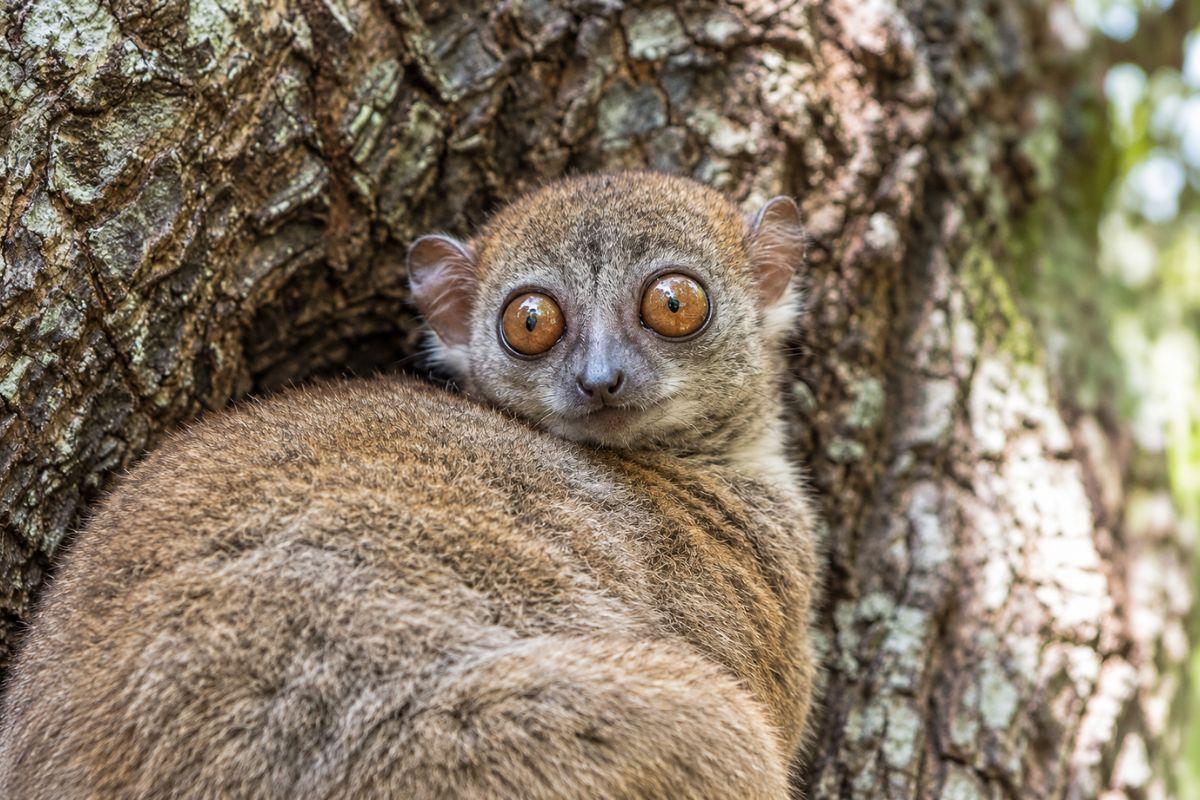
carnivore, but Kirindy is equally fascinating for its lemurs, microcebus,
reptiles, birds and unusual dry-forest ecology.
Unlike Madagascar’s humid eastern rainforests, Kirindy experiences a pronounced
dry season. Many trees lose their leaves, visibility through the forest changes
dramatically and wildlife has adapted to highly seasonal conditions.
Kirindy fits naturally into a journey through
Western Madagascar
,
particularly when combined with
Morondava
and the
Avenue of the Baobabs
.
Kirindy is one of the strongest wildlife stops in western Madagascar.
Its dry forest offers a completely different experience from parks such as
Ranomafana or Andasibe. The canopy is lower, the forest floor is drier
and seasonal changes are far more visible.
Kirindy is particularly well known for nocturnal wildlife and for the possibility
of encountering the fossa, Madagascar’s largest native predator.
It is also easy to combine with the Avenue of the Baobabs, making the region
especially rewarding for travellers who want both wildlife and landscapes.
The name “Kirindy Reserve” is commonly used in tourism,
but the protected-area context is more precise.
The well-known Kirindy Forest, historically called Kirindy CFPF
and now often referred to as Kirindy CNFEREF, lies within the larger
Menabe Antimena Protected Landscape.
Official protected-area information explains that Kirindy was formerly
a forest concession of around 10,000 hectares that later became an important
site for forestry research, conservation and ecotourism.
The wider Menabe Antimena protected landscape was formally created in 2015
and now covers more than 210,000 hectares.
Important distinction
Kirindy Forest near Morondava is not the same place as
Kirindy Mité National Park farther south. The two names are often confused,
but they refer to different protected areas.
Kirindy is particularly famous for the fossa
(Cryptoprocta ferox), Madagascar’s largest native carnivore.
The fossa has a long body, powerful limbs and remarkable climbing ability.
It is a highly effective predator capable of hunting both on the ground
and in trees.
Madagascar’s National Tourism Board specifically highlights Kirindy
as a place where visitors may observe the fossa.
Sightings remain wildlife encounters rather than guarantees.
Activity varies with season, time of day and natural behaviour.
Wildlife comes first
Never approach, feed or attempt to attract a fossa.
Observation should always follow guide instructions
and prioritise natural behaviour.
The strongest Kirindy experience combines daytime
and nocturnal wildlife walks.
Explore the forest with a local guide while looking for
Madagascar’s largest native carnivore.
Search for mouse lemurs, fork-marked lemurs,
reptiles and other nocturnal wildlife after dark.
Verreaux’s sifakas are among the lemurs associated
with the dry forests of Kirindy.
Walk beneath a forest adapted to long dry periods
and strong seasonal changes.
Kirindy also supports snakes, lizards,
birds and many smaller dry-forest species.
Combine wildlife with baobabs, rivers and limestone landscapes.
The forest itself is one of the main reasons Kirindy is so interesting.
Kirindy lies within a region with a pronounced dry season.
Many trees lose their leaves to reduce water loss,
creating a forest that can look radically different
depending on the time of year.
Kirindy forms part of the much larger Menabe Antimena
protected landscape.
Official protected-area information describes this wider region
as a mosaic of dry forest, wetlands, mangroves and coastal habitats.
Kirindy is particularly interesting because both diurnal
and nocturnal lemurs occur within the forest.
Madagascar’s National Tourism Board specifically mentions sifakas,
mouse lemurs and fork-marked lemurs among the species that can be observed.
Small nocturnal lemurs are especially difficult to locate without
experienced guides, which makes night walks one of the most valuable
wildlife experiences in Kirindy.
Sightings vary naturally from one visit to another.
Kirindy is well known among researchers and wildlife enthusiasts
for its tiny nocturnal mouse lemurs.
These animals emerge after dark and may be detected by movement,
calls or reflected eyeshine among branches.
A night walk reveals a completely different side of the forest.
Besides lemurs, visitors may encounter geckos,
chameleons, insects and other nocturnal species.
Kirindy is also associated with one of western Madagascar’s most unusual mammals:
the Malagasy giant rat, locally known as the vositse.
Madagascar’s National Tourism Board includes this endemic animal among
the distinctive wildlife of Kirindy Forest.
It is another reminder that Kirindy’s biodiversity extends far beyond
lemurs and fossa.
Kirindy has been studied extensively by foresters,
ecologists and primate researchers.
Official protected-area documentation notes research plots
and facilities associated with CNFEREF and the German Primate Center.
Long-term research has helped build a detailed understanding
of the forest’s wildlife and seasonal ecology.
It also reinforces Kirindy’s value as more than a tourism stop:
it is an important scientific landscape in western Madagascar.
Kirindy and the Avenue of the Baobabs form one of the strongest
combinations in western Madagascar.
The official route to Kirindy from Morondava passes via the RN8
and the Avenue of the Baobabs.
This makes it possible to combine a wildlife-focused forest experience
with one of Madagascar’s most iconic landscapes.
A particularly satisfying itinerary can include Kirindy during the day
or overnight, followed by the Avenue around sunset or sunrise.
Kirindy is most commonly approached from Morondava,
the main tourism hub of the Menabe region.
Official protected-area information describes the route
from Morondava via the RN35 and then north on the RN8
through the Avenue of the Baobabs.
Access is by road, but conditions worsen significantly
during the rainy season.
Current road conditions should therefore be confirmed
before planning precise transfer times.
Drier months generally make road access easier
and walking conditions more straightforward.
The forest also becomes more open as many trees lose their leaves.
Official protected-area information notes that road conditions
deteriorate considerably between roughly December and April.
Wildlife activity may also vary seasonally,
so planning should consider both access and the species
you most hope to observe.
Plan for the wider region
See our
guide to the best time to visit Madagascar
before combining Kirindy with Morondava and Tsingy de Bemaraha.
Wildlife in dry forest can be surprisingly difficult to locate.
Small lemurs, reptiles and nocturnal animals are easily missed
without experienced eyes.
Official protected-area information also recommends using local guides
recognised by site managers because of the isolation of parts of the region.
A guide also helps explain the ecology of the forest,
identify tracks and calls and adapt walks to seasonal conditions.
Fossa, sifakas, nocturnal lemurs and endemic mammals
make Kirindy one of western Madagascar’s strongest wildlife stops.
Travellers interested in nocturnal wildlife will find
Kirindy particularly rewarding after dark.
Dry forest, distinctive wildlife and nearby baobab landscapes
provide very different photographic opportunities.
Combine dry-forest wildlife with one of Madagascar’s
most iconic landscapes.
Use Morondava as your main base for exploring
Menabe, Kirindy and the baobab landscapes.
Continue north for a dramatic change from dry forest
to extraordinary limestone formations.
Add a multi-day river journey through western Madagascar
before continuing towards Menabe.
Kirindy works particularly well as part of a longer journey
through the Menabe region.
A strong route can begin in Morondava, pass through the Avenue
of the Baobabs and continue into Kirindy for wildlife walks.
From there, travellers with more time can continue north
towards Belo-sur-Tsiribihina and Tsingy de Bemaraha.
Kirindy is accessed by road from Morondava,
with the route continuing north through the Avenue of the Baobabs.
Road conditions vary significantly with the season,
so current transfer times should be checked before travel.
A day visit can provide a good introduction,
but staying overnight is more rewarding if nocturnal wildlife
is a priority.
Night walks reveal a very different set of species
from daytime excursions.
Bring sufficient drinking water, lightweight clothing,
insect repellent, closed walking shoes and sun protection.
A headlamp or torch may also be useful for nocturnal excursions,
depending on arrangements with your guide.
No. Kirindy is a natural forest,
and fossa, lemurs and other animals move freely.
A good guide improves the chances of observation,
but no responsible operator should promise a particular sighting.
Official protected-area information describes Menabe Antimena
as a landscape where remaining forest blocks are increasingly fragmented.
Pressures include land conversion, fire
and degradation around settlement areas.
Well-managed ecotourism can support conservation,
guiding and research activities within the region.
Travellers can help by following designated trails,
avoiding wildlife feeding and using authorised local guides
and tourism services.
Yes. Kirindy is particularly rewarding for travellers interested
in fossa, lemurs, nocturnal wildlife and the dry forests
of western Madagascar.
Kirindy is best known for its dry deciduous forest,
fossa, sifakas, mouse lemurs, other nocturnal lemurs
and endemic wildlife.
Fossa occur in Kirindy and the reserve is well known
for possible encounters, but sightings are never guaranteed.
No. The Kirindy Forest near Morondava is not Kirindy Mité National Park.
It lies within the larger Menabe Antimena Protected Landscape
and is commonly known as Kirindy Forest or Kirindy CNFEREF.
Night walks are one of the most rewarding ways to experience Kirindy,
especially for mouse lemurs, fork-marked lemurs,
reptiles and other nocturnal animals.
Yes. The road from Morondava to Kirindy passes through
the
Avenue of the Baobabs
,
making the two destinations a natural combination.
It is recommended if nocturnal wildlife is important to you,
because evening walks offer a very different experience
from daytime forest visits.
Drier months generally provide easier road access,
while the rainy season can make roads significantly more difficult.
Wildlife activity also changes with season.
Kirindy combines dry forest, fossa, lemurs and nocturnal wildlife
with easy access to the extraordinary baobab landscapes of Menabe.
Natura Travel can integrate the reserve into a private western Madagascar
journey linking Morondava, the Avenue of the Baobabs,
the Tsiribihina region and Tsingy de Bemaraha.