Grand Tsingy
The Grand Tsingy offers the most dramatic and adventurous experience,
with towering limestone formations, elevated viewpoints and sections
that require secure movement across rugged terrain.
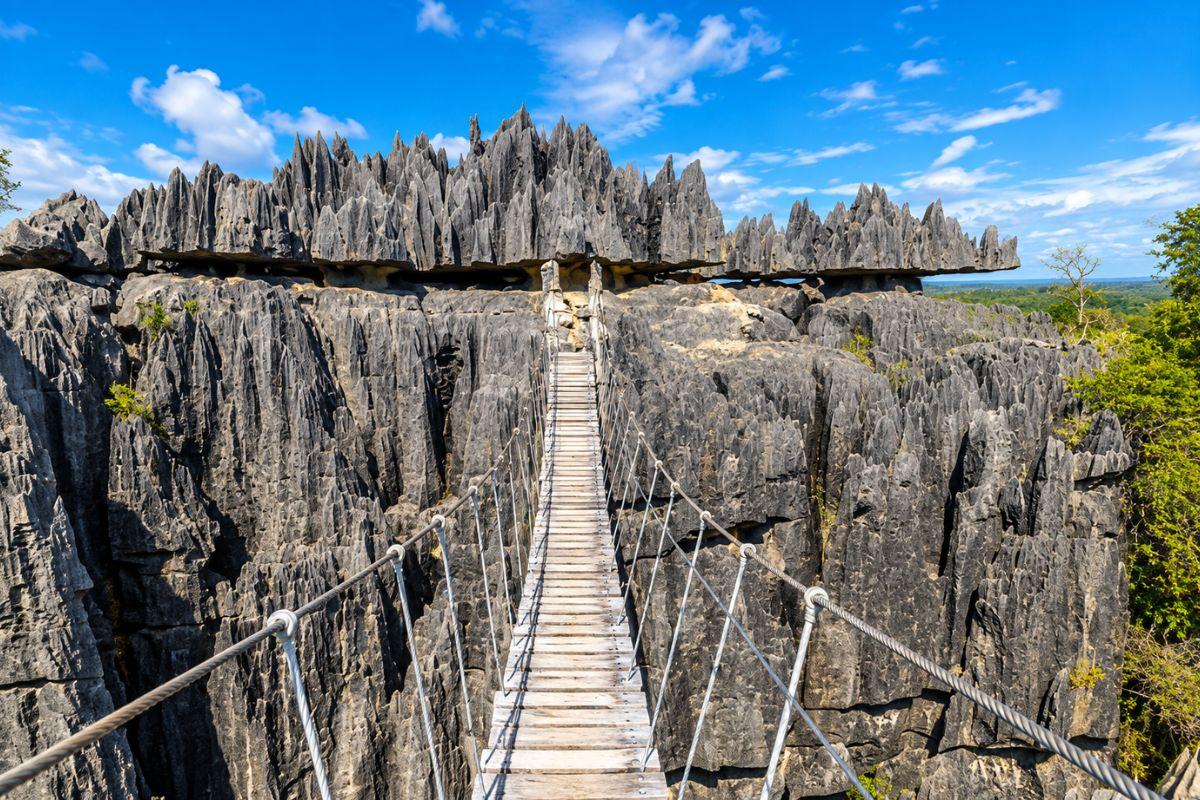
Located in western Madagascar, this protected area is famous for its spectacular tsingy:
sharp karst formations that rise like a stone forest above a landscape of cliffs, gorges,
dry deciduous forest and hidden pockets of biodiversity.
For many travellers, Tsingy de Bemaraha is one of the most memorable highlights of
Western Madagascar
,
especially when combined with
Morondava
,
the
Avenue of the Baobabs
,
Kirindy Reserve
and the
Tsiribihina River
.
Tsingy de Bemaraha is not just a place to visit, it is a destination to experience:
adventurous access, extraordinary geology, rare wildlife and a landscape that feels
truly remote and world-class.
Tsingy de Bemaraha is one of the most visually spectacular destinations in Madagascar.
The landscape combines jagged limestone spires, elevated viewpoints,
suspended bridges, dry forest, deep river gorges and an atmosphere of true remoteness.
It is also one of the best places in Madagascar for travellers looking for something
more adventurous than a classic scenic stop. Visiting the tsingy is not simply about
seeing a viewpoint, it is about moving through a remarkable environment shaped by geology,
climate and time.
If you want a destination that feels dramatic, memorable and very different from
Madagascar’s beaches, rainforests or Highlands, Tsingy de Bemaraha is one of the strongest
choices in the country.
Tsingy de Bemaraha is today managed by Madagascar National Parks and is recognised
as one of Madagascar’s major protected landscapes.
The protected area was originally created as a strict nature reserve and later,
in 2011, its status and boundaries were modified so that it became
Tsingy de Bemaraha National Park.
The protected area currently covers more than 157,000 hectares,
making it one of the most significant conservation landscapes in western Madagascar.
Sources & Local Context
The legal status, current surface area, access routes and visitor information
on this page are based on official protected-area sources and UNESCO documentation.
Tsingy de Bemaraha is not only one of Madagascar’s great natural attractions,
it is also part of a globally recognised conservation landscape.
UNESCO currently presents this western Madagascar World Heritage property
as the Andrefana Dry Forests, a serial site that includes karst landscapes,
limestone uplands, tsingy peaks, dry forests, lakes and mangroves.
Tsingy de Bemaraha is one of the best-known and most iconic components
of this wider UNESCO context.
UNESCO highlights the spectacular karst formations, the canyon of the Manambolo River
and the habitat value of these western dry forests for rare and threatened biodiversity.
This gives Tsingy de Bemaraha a significance that goes far beyond tourism alone.
The word “tsingy” refers to sharp limestone formations that create a landscape
of pinnacles, ridges, fissures and stone needles.
In Bemaraha, these formations stretch across a vast karstic limestone plateau
cut by long fractures and deep natural corridors.
This is what gives the park its famous “stone forest” appearance:
a labyrinth of razor-like limestone peaks that feels almost unreal when seen from above.
The visual power of the destination comes from this geology, but also from the contrast
between rock, dry forest and the Manambolo Gorge cutting through the massif.
The experience of Tsingy de Bemaraha is usually understood through two main visitor areas.
The Grand Tsingy offers the most dramatic and adventurous experience,
with towering limestone formations, elevated viewpoints and sections
that require secure movement across rugged terrain.
The Petit Tsingy provides a shorter and generally more accessible introduction
to the limestone formations, while still delivering impressive scenery.
If time allows, combining Grand Tsingy and Petit Tsingy creates a much fuller
understanding of the site, balancing major views with a more approachable circuit.
Tsingy de Bemaraha is not just a sightseeing stop. It is a multi-layered destination
where geology, adventure and wildlife all come together.
Experience the most spectacular circuits through the limestone formations,
where height, exposure and unforgettable viewpoints define the visit.
Explore a shorter route that reveals the character of the stone forest
without requiring the same level of effort as the main circuits.
The deep Manambolo River gorge is one of the defining landscape features
of the Bemaraha massif and adds another dimension to the experience.
Dry forest, cliffs and isolated habitats support lemurs, birds,
reptiles and other wildlife adapted to western Madagascar.
Reaching the park itself is part of the experience,
with 4×4 travel, ferries and a sense of remoteness rarely found
on easier classic routes.
Tsingy de Bemaraha fits naturally into a longer west Madagascar itinerary
with baobabs, dry forest and river landscapes.
Tsingy de Bemaraha is one of Madagascar’s most rewarding destinations,
but it is also one of the least casual to access.
Reaching the park usually involves a long 4×4 transfer, seasonal road considerations
and ferry crossings over western Madagascar’s rivers.
Once there, some circuits require security equipment and confident movement
across rocky terrain and suspended sections.
This is exactly what makes the destination so memorable:
it feels earned, remote and genuinely different from more accessible sites.
Tsingy de Bemaraha is a site where route planning matters.
Official protected-area information notes a range of tourist circuits,
mainly in the Bekopaka area, with one additional circuit near Antsalova.
This allows travellers to choose visits according to time, fitness
and interest level.
Some trails through the tsingy include platforms, viewpoints
and suspended bridges, and certain sites require security equipment
such as a climbing harness.
The visit should therefore be approached as an active excursion,
not as a simple roadside stop.
Important practical advice
Bring enough drinking water, wear proper walking shoes
and plan the visit with a local guide familiar with current circuit conditions.
One of the most striking landscape features of Tsingy de Bemaraha
is the gorge of the Manambolo River.
This deep canyon cuts through the southern part of the Bemaraha plateau
and adds an entirely different scale and mood to the destination.
The gorge helps explain why Tsingy de Bemaraha feels so varied:
the landscape is not only vertical limestone, but also river systems,
cliffs, dry forest and hidden ecological corridors.
For travellers, the Manambolo contributes to the feeling of being in
one of Madagascar’s most distinctive and dramatic natural regions.
Although the limestone formations are the headline attraction,
Tsingy de Bemaraha is also an important biodiversity landscape.
UNESCO identifies the wider site as habitat for rare and endangered lemurs,
making the park significant not only geologically but also biologically.
Dry forest, cliff habitats and the wider western ecosystem support
notable birdlife, including endemic and threatened species.
The combination of karst formations, forest pockets and seasonal climate
supports a rich range of reptiles and other species adapted to western Madagascar.
One of the most important things to understand about Tsingy de Bemaraha
is that it is not only a limestone landscape.
UNESCO describes the wider World Heritage context as including dry forests,
lakes and mangrove environments, while official protected-area information
describes the park as part of a mosaic of forests, grasslands and plateau habitats.
This ecological diversity is part of what makes the destination so special:
it is a geological wonder, but also a living western Malagasy ecosystem.
Access is part of the character of the journey.
The principal southern access is through Bekopaka,
which functions as the main visitor gateway for most travellers.
Official protected-area information places this entrance
about 200 km north of Morondava.
The classic route from Morondava follows the RN35 and RN8,
passes the Avenue of the Baobabs and requires crossing
both the Tsiribihina and Manambolo rivers by ferry.
A four-wheel-drive vehicle is necessary.
Alternative access
An additional entrance exists via Antsalova,
and the region may also be approached from the north during the dry season.
Tsingy de Bemaraha is strongly seasonal.
Official protected-area information states that during the rainy season,
roughly from December to April, access becomes difficult and much of the tourist
infrastructure closes.
In practice, the dry season is the most suitable time for visiting,
both for road access and for park circuits.
If you are planning a wider western itinerary, the timing of Tsingy de Bemaraha
should be coordinated carefully with Morondava, Kirindy and the Tsiribihina region.
See our
guide to the best time to visit Madagascar
.
Tsingy de Bemaraha is a place of rugged terrain,
complex circuits and isolated conditions.
Official guidance recommends using local guides,
particularly because of the site’s difficulty and isolation.
A good guide does more than lead the way.
They help explain the geology, spot wildlife
and adapt the excursion to your interests and fitness level.
For a destination like Bemaraha, guided travel is not just helpful,
it is part of what makes the visit more meaningful.
Tsingy de Bemaraha is not only a natural landscape.
Official protected-area information notes that the Bemaraha massif
includes sites of importance to local Sakalava and Vazimba communities.
The area includes tombs, sacred sites and places connected to local customs and rites.
This matters for travellers because the park should not be approached
as an empty wilderness. It is also a cultural landscape where respect,
discretion and local guidance are important.
Travel respectfully
Follow local instructions, respect sacred places and do not assume
every viewpoint or natural feature is only a tourism site.
Tsingy de Bemaraha is usually at its best when integrated into a wider western Madagascar itinerary.
Use Morondava as the main base for organising the overland journey north
towards Bekopaka and the Tsingy.
The route towards Bekopaka naturally connects with one of Madagascar’s
most iconic landscapes.
Add dry-forest wildlife, fossa and nocturnal lemurs
for a more complete Menabe itinerary.
For a more adventurous journey, combine the west with a slower river experience
before or after continuing towards the limestone massif.
Tsingy de Bemaraha is one of the anchor destinations of a serious western Madagascar route.
A classic itinerary often begins in Morondava, includes the Avenue of the Baobabs,
can add Kirindy Reserve, and then continues north towards Bekopaka and the Tsingy.
Depending on time and style of travel, some itineraries also connect
with the Tsiribihina River.
If you enjoy remote routes, active excursions and destinations
that feel truly different, Tsingy de Bemaraha is a standout choice.
The limestone pinnacles, cliffs and dramatic viewpoints
make this one of Madagascar’s most unforgettable landscapes.
The combination of geology, dry forest and rare wildlife
gives the destination strong appeal beyond its visual drama alone.
Avoid trying to rush Tsingy de Bemaraha.
Because of the travel time and the different circuits available,
the destination deserves enough time to experience it properly.
Wear solid walking shoes with good grip and clothing suitable
for active movement in a hot, dry environment.
Bring sun protection and enough water,
especially for longer circuits.
Difficulty varies by circuit.
The Petit Tsingy can provide a more accessible introduction,
while sections of the Grand Tsingy are more physically demanding.
In practice, no. Seasonal access constraints are a major factor here.
During the rainy season, roads become difficult and much of the tourist
infrastructure closes, so the dry season is the realistic visiting window.
Tsingy de Bemaraha protects a rare combination of geological formations,
dry forests and habitat for threatened biodiversity.
Its conservation value is national and international,
which is why the UNESCO dimension is so important.
Official protected-area information identifies threats including fire,
illicit logging, forest clearing and continued hunting pressure in some areas.
Responsible tourism should therefore support conservation,
respect local rules and minimise ecological disturbance.
Yes. It is one of Madagascar’s most extraordinary and distinctive destinations,
combining UNESCO-level significance, dramatic limestone formations
and a real sense of adventure.
Tsingy de Bemaraha is famous for its jagged limestone pinnacles,
karst plateau, suspended viewpoints, the Manambolo Gorge
and its protected dry-forest landscape.
Tsingy de Bemaraha forms part of the UNESCO World Heritage context
now presented as the
Andrefana Dry Forests,
which includes major western Madagascar landscapes and ecosystems.
It is located in western Madagascar.
The main visitor access for most travellers is via Bekopaka,
north of
Morondava
.
The classic overland route is from Morondava by 4×4 via the RN35 and RN8,
passing the
Avenue of the Baobabs
and crossing the Tsiribihina and Manambolo rivers by ferry.
The dry season is the practical time to visit.
During the rainy season, access becomes difficult
and much of the tourist infrastructure closes.
You should plan to visit with a local guide,
especially because of the site’s rugged terrain, safety considerations
and the complexity of the circuits.
Yes. Morondava is the classic starting point for a Tsingy journey
and combines naturally with the
Avenue of the Baobabs
and
Kirindy Reserve
.
It depends on the circuit.
The Petit Tsingy is generally easier,
while the Grand Tsingy involves a more demanding and adventurous visit.
Tsingy de Bemaraha is one of Madagascar’s greatest adventure destinations:
a UNESCO-recognised limestone world of cliffs, dry forest, rare wildlife
and unforgettable viewpoints. Natura Travel can integrate the park
into a private western Madagascar itinerary linking Morondava,
the Avenue of the Baobabs, Kirindy Reserve and the Tsiribihina region.