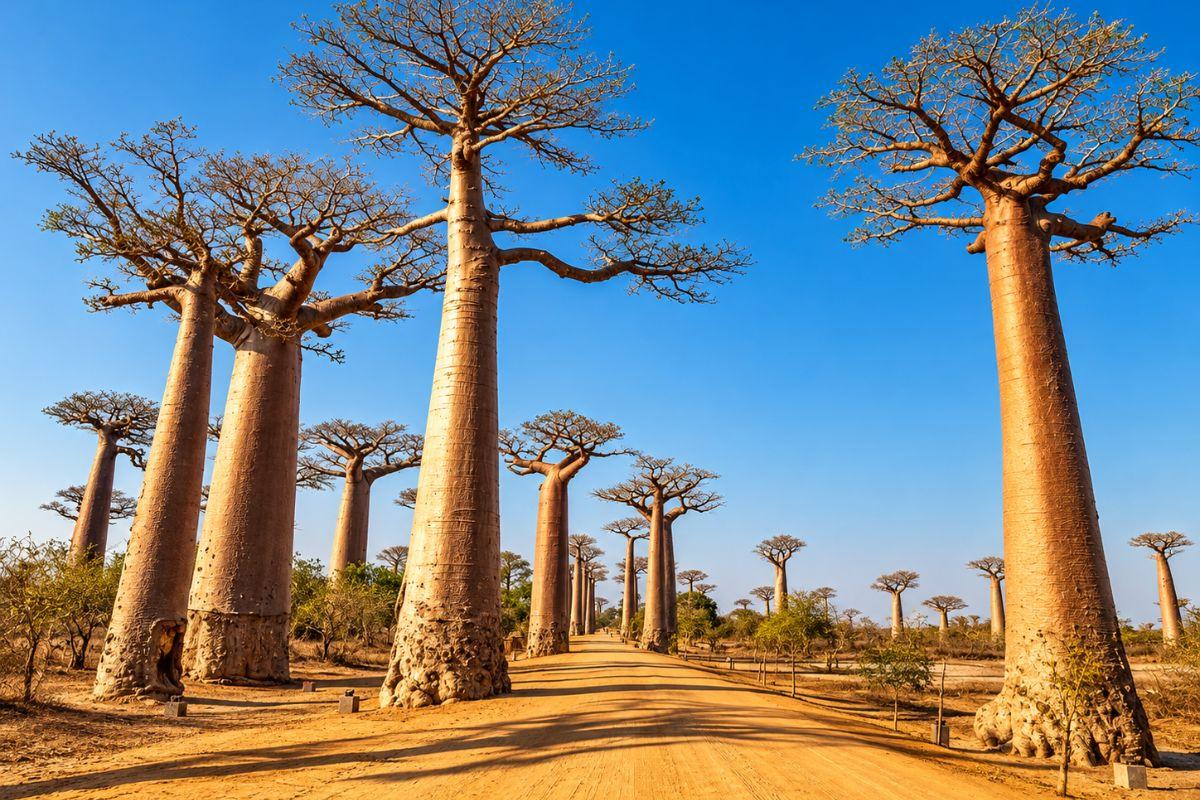
Visit the Avenue of the Baobabs
See giant Grandidier’s baobabs rising above the Menabe plains,
especially around sunrise or sunset.
Set on the Mozambique Channel in the Menabe region, Morondava combines
a relaxed coastal atmosphere with access to wildlife, baobabs,
fishing communities and some of Madagascar’s most adventurous overland journeys.
Many travellers know Morondava because of the
Avenue of the Baobabs
,
but the town is much more useful when treated as the starting point
for a wider exploration of
Western Madagascar
.
Morondava gives travellers access to several of the experiences
that define western Madagascar.
Within the wider region, you can photograph giant baobabs at sunset,
search for fossa and lemurs in dry deciduous forest,
visit Vezo fishing communities and continue north towards
the spectacular limestone formations of Tsingy de Bemaraha.
The city itself provides a useful place to slow down between excursions,
enjoy the coast and organise the more demanding road journeys
that characterise travel through western Madagascar.
For this reason, Morondava works best as a regional base rather
than simply as an overnight stop.
Madagascar’s National Tourism Board consistently presents Morondava
as the gateway to the famous Avenue of the Baobabs and Kirindy Forest.
Recent official tourism programmes combine Morondava with Kirindy,
the Baobabs in Love, the Avenue of the Baobabs and Belo-sur-Mer.
This reflects the real strength of the destination:
Morondava links the dry forests and baobab landscapes of inland Menabe
with fishing communities and marine environments along the Mozambique Channel.
Sources & Local Context
The regional connections described on this page are supported
by recent itineraries published by Madagascar’s National Tourism Board.
The strongest Morondava itinerary combines landscapes,
wildlife and coastal culture rather than focusing only on one attraction.
See giant Grandidier’s baobabs rising above the Menabe plains,
especially around sunrise or sunset.
Walk through dry deciduous forest in search of fossa,
sifakas, mouse lemurs and other endemic wildlife.
Discover a Vezo fishing community known for colourful sailing pirogues,
traditional dhow construction and coastal scenery.
Morondava’s position on the Mozambique Channel adds beaches,
sunsets and a relaxed coastal rhythm to a wildlife-focused itinerary.
Stop at the famous intertwined baobabs often visited
on the journey between Kirindy and Morondava.
Travel north towards rivers, ferries and the spectacular
limestone landscapes of Tsingy de Bemaraha.
The Avenue of the Baobabs is the landscape most closely associated
with Morondava.
Madagascar’s National Tourism Board repeatedly includes the site
in official Morondava programmes, particularly around sunset,
when the trunks of the giant trees take on warm colours
against the western sky.
The Avenue is primarily known for Grandidier’s baobab,
Adansonia grandidieri, one of Madagascar’s endemic baobab species.
Rather than treating it as an isolated roadside photo stop,
combine the Avenue with the wider Menabe landscape
and nearby Kirindy Forest.
Kirindy is one of the most important wildlife experiences
accessible from Morondava.
Kirindy protects dry deciduous forest with high levels
of endemic wildlife.
Madagascar’s National Tourism Board highlights fossa,
sifakas, mouse lemurs, other nocturnal lemurs,
reptiles and the Malagasy giant rat among the animals
associated with the forest.
Daytime and nocturnal excursions provide very different experiences.
Staying overnight near Kirindy can be worthwhile
if nocturnal wildlife is a major priority.
South of Morondava, Belo-sur-Mer offers a completely different
side of western Madagascar.
Madagascar’s National Tourism Board describes Belo-sur-Mer
as a Vezo fishing village known for colourful pirogues
and traditional sailing dhows.
The village also preserves an artisanal shipbuilding tradition,
where large wooden boats are constructed using techniques
passed down over generations.
Official tourism programmes have combined Morondava with boat travel
to Belo-sur-Mer, visits to the fishing community,
the local shipyard and nearby coral environments.
Practical note
Boat conditions, sea conditions and transfer arrangements can change.
Confirm the current logistics before building a fixed Belo-sur-Mer excursion
into your itinerary.
Along the western and southwestern coast of Madagascar,
Vezo communities are strongly associated with fishing,
pirogues and detailed knowledge of the sea.
Excursions south of Morondava provide opportunities
to understand how coastal livelihoods differ from
inland Menabe communities.
Fishing villages are living communities rather than attractions
created for tourism.
Ask before photographing people, follow local guidance
and support locally operated services where possible.
The wider Morondava area also includes important mangrove environments.
Madagascar’s National Tourism Board has highlighted the community-managed
Kivalo circuit, created to showcase the ecological richness
of a large mangrove forest.
Mangroves provide nursery habitats for marine life,
protect coastlines and support fishing communities.
Adding a mangrove experience gives a broader understanding
of western Madagascar beyond baobabs and dry forest.
Morondava is a working regional centre as well as a tourism base.
The Mozambique Channel gives Morondava a warmer,
more relaxed coastal character than Madagascar’s Highlands.
The town provides accommodation, transport and services
for travellers continuing towards Kirindy,
Belo-sur-Mer or Tsingy de Bemaraha.
Markets and neighbourhoods provide a glimpse of everyday life
in the Menabe region beyond the major tourist sites.
For many travellers, Morondava is also the starting point
for one of Madagascar’s most adventurous overland journeys:
the route north towards Tsingy de Bemaraha.
The journey passes through western landscapes and requires
significant road travel, with conditions that vary seasonally.
The reward is access to one of Madagascar’s most extraordinary
limestone environments and a UNESCO World Heritage landscape.
Tsingy de Bemaraha should not be treated as a quick day excursion
from Morondava. It needs enough time for the journey
as well as for exploring the protected area itself.
The Tsiribihina River offers an alternative way to experience
western Madagascar through river landscapes,
villages and slower travel.
Multi-day river journeys can form part of a larger route
eventually connecting with Menabe and Morondava.
River itineraries depend on operators, water conditions
and current transport arrangements.
They should be planned as part of a structured western itinerary
rather than added casually at the last minute.
Morondava is the natural base for seeing
the Avenue of the Baobabs at sunrise or sunset.
Nearby Kirindy provides access to dry-forest wildlife,
including fossa, lemurs and nocturnal species.
Morondava is an important starting point for longer journeys
towards the Tsingy and other remote areas of western Madagascar.
See one of Madagascar’s most recognisable landscapes
just outside the Morondava region.
Add fossa, lemurs, night walks
and the dry deciduous forest of Menabe.
Continue north to one of Madagascar’s
most extraordinary limestone wildernesses.
Add a multi-day river journey for a slower
and more adventurous exploration of western Madagascar.
Morondava is the central hub of one of Madagascar’s most distinctive regional journeys.
A shorter route can combine Morondava,
the Avenue of the Baobabs and Kirindy.
With more time, travellers can continue north towards Belo-sur-Tsiribihina
and Tsingy de Bemaraha, or build the region into a longer itinerary
involving the Tsiribihina River.
This creates a journey through baobab landscapes,
dry forest, wildlife, rivers and limestone formations.
Morondava can be reached by air or by road,
depending on the wider itinerary and current transport services.
Flight schedules and overland journey times can change,
so current connections should be confirmed when booking.
Avoid planning Morondava as a one-night stop
if you want to experience both the Avenue of the Baobabs
and Kirindy properly.
Additional time is required for Belo-sur-Mer
or a journey towards Tsingy de Bemaraha.
Seasonal rainfall has a major influence on road conditions
in western Madagascar.
Drier periods generally make overland travel towards Kirindy
and Tsingy de Bemaraha more straightforward.
Sun protection, lightweight clothing,
insect repellent and comfortable walking shoes are useful.
For Kirindy or longer western journeys,
also prepare for dust, rough roads
and significant temperature differences between day and night.
Western Madagascar’s remaining dry forests
are under pressure from fire, land conversion
and habitat fragmentation.
Use authorised guides, respect protected areas
and avoid disturbing or feeding wildlife.
Local guides, community-managed mangrove sites,
fishing villages and craft producers all provide ways
for tourism to contribute more directly to regional livelihoods.
Respecting local customs and asking permission before photographing
people is especially important in rural communities.
Yes. Morondava is particularly worthwhile as the gateway
to the Avenue of the Baobabs, Kirindy Forest
and the wider landscapes of western Madagascar.
Morondava is most famous for the nearby Avenue of the Baobabs,
but it is also an important base for Kirindy,
Belo-sur-Mer and longer journeys towards Tsingy de Bemaraha.
Yes. Morondava is the main base for visiting the
Avenue of the Baobabs
,
and the site is commonly combined with Kirindy.
Yes. Kirindy is reached north of Morondava
via the route passing the Avenue of the Baobabs.
Staying near Kirindy can be useful if you want to include a night walk.
Yes. Official tourism programmes have included boat excursions
between Morondava and Belo-sur-Mer, although current sea
and transfer arrangements should be checked before travel.
Yes. Morondava is one of the main starting points
for journeys towards
Tsingy de Bemaraha
.
The journey requires substantial overland travel
and should be planned according to seasonal road conditions.
Allow enough time for at least the Avenue of the Baobabs
and Kirindy if wildlife is part of your plans.
Belo-sur-Mer and Tsingy de Bemaraha require additional time.
Drier months generally make travel through western Madagascar easier,
especially when continuing towards Kirindy or Tsingy de Bemaraha.
Exact conditions should still be checked before departure.
Morondava is the gateway to giant baobabs, dry-forest wildlife,
Vezo coastal culture and some of western Madagascar’s most adventurous landscapes.
Natura Travel can integrate Morondava into a private journey linking
the Avenue of the Baobabs, Kirindy, the Tsiribihina region
and Tsingy de Bemaraha.