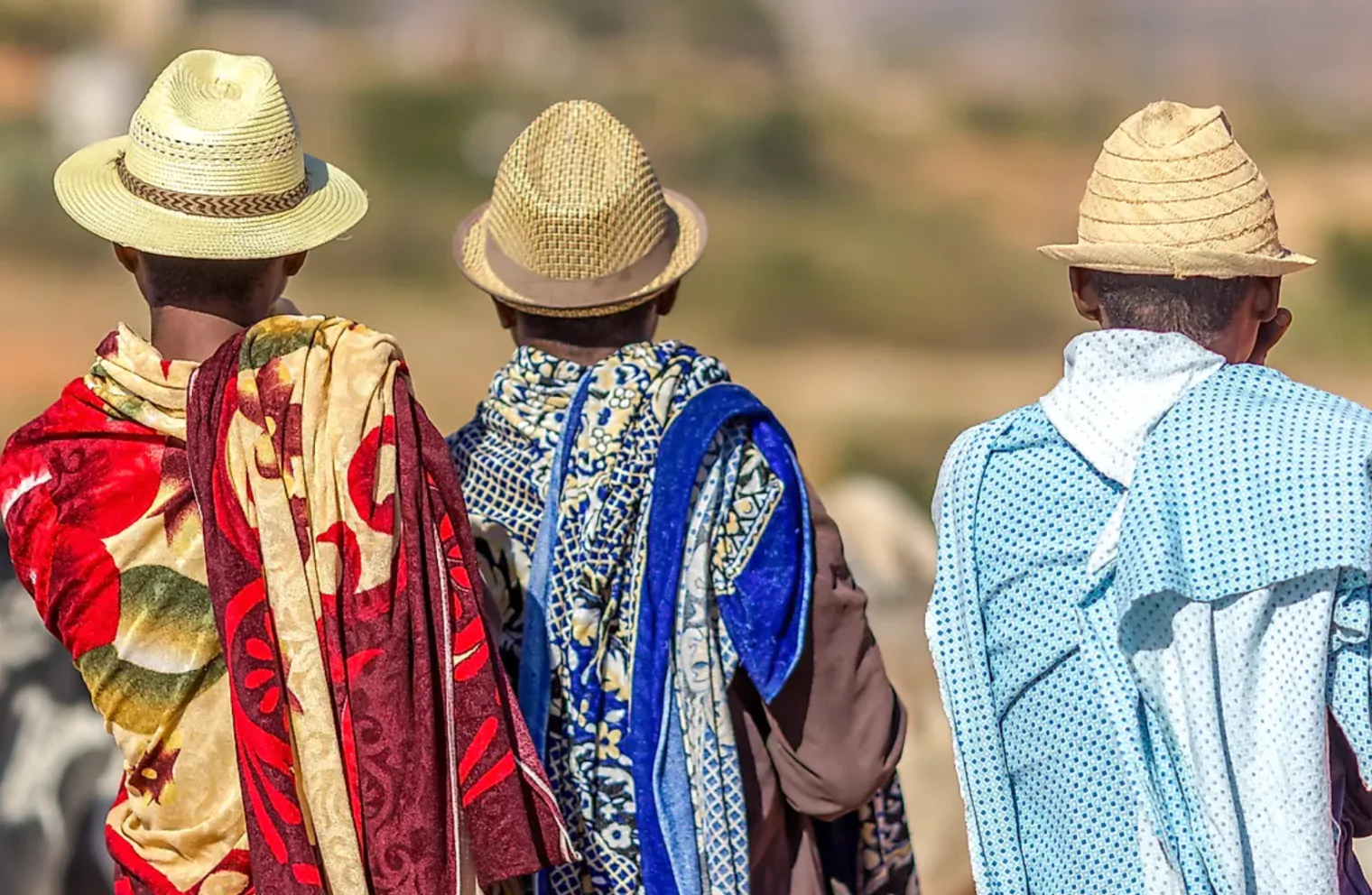
Madagascar is famous for its lemurs, baobabs, rainforests and extraordinary landscapes, but discovering the island also means entering a country with a remarkably rich cultural heritage.
Malagasy culture has been shaped over centuries by Austronesian and African roots, as well as later Arab, Indian and European influences. Yet speaking of a single Madagascar culture can be misleading. Traditions, dialects, beliefs, architecture, food and ceremonies can change considerably as you travel from the Central Highlands to the east coast, the dry south, the west or the northern regions.
What unites these different communities is a strong relationship with family, ancestors, land and community life.
For travelers, understanding a few Malagasy customs can completely change the experience of visiting Madagascar. A village, a tomb, a market or a traditional ceremony becomes much more meaningful once you understand the cultural values behind what you are seeing.
Before planning your journey, you may also want to read our 21 Essential Things to Know Before Travelling to Madagascar, which covers transport, climate, language, wildlife and practical travel advice.
What Makes Malagasy Culture Unique?
Madagascar’s location in the Indian Ocean helps explain its extraordinary cultural identity.
The Malagasy language belongs to the Austronesian language family, reflecting ancient links with Southeast Asia, while the island’s population and cultural history also have deep African roots. Over centuries, trade and migration brought additional influences from the Arab world, India and Europe.
The result is not simply a mixture of cultures.
Madagascar developed its own social values, customs, belief systems, artistic traditions and ways of understanding the relationship between the living and the dead.
One of the best examples is the concept of fihavanana.
Fihavanana: The Importance of Family and Community
There is no perfect English translation of fihavanana.
The word is related to havana, meaning family or relatives, but the idea extends beyond immediate family. Fihavanana can express kinship, solidarity, mutual responsibility, good relationships and the importance of preserving harmony within a community.
In everyday life, this can be reflected in helping relatives, supporting neighbors, participating in family events and maintaining social relationships over generations.
For travelers, this helps explain why interactions in Madagascar can sometimes feel more personal than transactional.
Taking time to greet someone properly, showing interest in the people you meet and treating hosts, guides and villagers respectfully can matter as much as the activity itself.
It is one reason why traveling slowly through Madagascar can be so rewarding. Some of the most memorable moments are not necessarily at famous tourist attractions. They can happen during a conversation in a village, a visit to a craft workshop or a meal shared with local people.
Ancestors and the Malagasy Relationship with the Past
Respect for ancestors is one of the most fascinating aspects of many Malagasy traditions.
Traditional beliefs often view the relationship between the living and their ancestors as continuing after death. Ancestors may remain connected with the family, the land and the community.
This helps explain the cultural importance of family tombs in many regions.
A tomb should therefore never be treated simply as an interesting building or photographic subject. Depending on the community, it may be a sacred place governed by specific rules.
Visitors should avoid entering, touching or photographing tombs unless a local guide or community member has clearly indicated that this is appropriate.
Famadihana: the Turning of the Bones
Perhaps the best-known Malagasy ancestral tradition is famadihana, often translated as the turning of the bones.
The ceremony is particularly associated with some communities of Madagascar’s Central Highlands.
During a famadihana, a family may reopen an ancestral tomb, rewrap the remains of deceased relatives in new cloth and gather with extended family members to honor their ancestors.
Music, conversation, food and family reunion can form part of the occasion.
However, famadihana should not be presented as something practiced by every Malagasy family or in every region. Customs surrounding death and ancestors vary considerably across the island.
Travelers should also remember that it is a family and cultural event, not a tourist performance.
If you are ever invited to attend a ceremony, follow the advice of your host or guide, dress respectfully and always ask before taking photographs.
Fady: The Local Taboos Every Traveler Should Understand
One Malagasy word every visitor should know is fady.
A fady is a prohibition or taboo connected to local customs, ancestors, sacred places, family traditions or community beliefs.
The most important thing to understand is that fady are local.
Something permitted in one village may be prohibited in another.
A fady might concern entering a particular place, eating certain foods, pointing at a tomb, wearing specific clothing, visiting a sacred site on a particular day or behaving in a certain way near a culturally important location.
This means it is almost impossible for a traveler to learn every fady before visiting Madagascar.
Fortunately, you are not expected to.
What matters is listening.
When a local guide tells you that something should not be done, respect the instruction even if the reason is not immediately obvious.
This is one of the major advantages of traveling with knowledgeable Malagasy guides. They do more than show you wildlife and landscapes. They help you understand the cultural context of the places you visit.
Kabary: When Speaking Becomes an Art
Words have a special place in Malagasy culture.
One of Madagascar’s most remarkable cultural traditions is kabary, a highly structured form of public oratory using proverbs, rhetorical expressions, metaphors and wordplay.
Kabary can be heard at weddings, family gatherings, funerals, public celebrations and official events.
Traditionally, skilled speakers known as mpikabary learn how to construct elaborate speeches and respond appropriately to another speaker.
The tradition is much more than public speaking. It transmits social values, history and collective memory from one generation to another.
UNESCO inscribed Malagasy kabary on the Representative List of the Intangible Cultural Heritage of Humanity in 2021.
If you attend a Malagasy wedding or important community event, you may therefore discover that speeches occupy a much larger place than you expected.
Patience is part of the experience.
Respect, Greetings and Everyday Etiquette in Madagascar
Understanding Madagascar culture does not require memorizing hundreds of rules.
A few simple attitudes will take you a long way:
- greet people before asking a question or starting a conversation;
- show particular respect toward older people;
- ask permission before photographing individuals, ceremonies or sacred places;
- listen carefully when a guide explains a local fady;
- avoid treating villages as attractions created for tourists;
- dress respectfully when entering communities or religious places;
- learn a few Malagasy words such as Salama for hello, Misaotra for thank you and Azafady for please or excuse me;
- remember that customs can change from one region to another.
Traveling respectfully often creates opportunities for more genuine encounters.
Marriage and the Vodiondry Tradition
Family plays an important role in Malagasy marriage traditions.
One of the best-known customs is the vodiondry, a traditional engagement or marriage-related ceremony involving the two families.
Historically, the word refers to the rump of a sheep, once considered a prestigious gift. Today, the ceremony can include symbolic gifts or money presented to the bride’s family.
The most interesting element for visitors is often not the gift itself, but the importance of family negotiations and speeches.
Kabary can play an important role during the ceremony, with representatives of the two families exchanging carefully structured speeches.
As with many Malagasy traditions, the exact form varies between families, communities and regions.
Rites of Passage and Family Ceremonies
Birth, childhood, marriage and the transition to adulthood can also be marked by traditional ceremonies.
Circumcision, for example, has historically been an important rite in many Malagasy communities, although the way it is practiced today varies enormously according to family, region and religion.
Other traditions relate to a child’s first haircut, family blessings or the choice of an auspicious date for important events.
In some families and communities, a mpanandro, traditionally associated with astrology and the interpretation of favorable dates, may be consulted.
Modern Malagasy life and traditional practices are not opposites. They often coexist.
A family may use smartphones, attend church, speak French at work and at the same time maintain traditions inherited from previous generations.
That coexistence is one of the reasons Malagasy culture is so interesting.
The Zebu: Much More Than Livestock
Travel through rural Madagascar and you will soon encounter the distinctive hump-backed zebu.
For visitors, it may initially appear to be simply cattle.
Culturally, its importance goes much further.
In various regions of Madagascar, zebu can represent wealth, social status and family prosperity. They may also have ceremonial importance and historically have played a role in weddings, funerals and other traditional events.
Their importance is particularly visible in parts of southern and western Madagascar, although cattle farming can be found across the island.
Zebu also appears constantly in Malagasy visual culture, markets, traditional crafts and cuisine.
Understanding its significance allows travelers to see rural landscapes differently. A herd of cattle is not simply an agricultural scene. It can also reflect social and cultural relationships that have developed over generations.
Malagasy Architecture: Culture Written Into the Landscape
One of the pleasures of traveling overland through Madagascar is watching the architecture change.
In the Central Highlands, traditional houses frequently use earth and brick and often rise over several floors.
Travel east and plant materials become much more visible. In other regions, local wood, reeds, raffia and other locally available materials influence construction.
Architecture therefore tells a story about climate, natural resources, history and cultural identity.
Even the orientation and organization of traditional houses can carry symbolic meaning in certain communities.
If this aspect of Madagascar interests you, continue with our guide to traditional Malagasy architecture.
Malagasy Craftsmanship and the Zafimaniry
Madagascar has an extraordinarily varied craft tradition.
Travelers may encounter weaving, embroidery, raffia work, horn carving, metalwork, handmade paper, basketry, silk production and wood carving.
Among the most remarkable traditions is the woodcrafting knowledge of the Zafimaniry.
Zafimaniry communities of southeastern Madagascar have developed sophisticated woodworking techniques over generations. Houses, beams, shutters, furniture and everyday objects can be decorated with geometric motifs carrying symbolic meanings.
Traditional constructions use complex joinery techniques, historically without nails or metal fittings.
UNESCO inscribed the woodcrafting knowledge of the Zafimaniry on its Representative List of the Intangible Cultural Heritage of Humanity in 2008.
Travelers particularly interested in craftsmanship and cultural landscapes can explore the Highlands and Zafimaniry country on Natura Travel’s Madagascar Adventure Tour through Ranomafana, Andringitra and Isalo.
The classic southern route also passes through places such as Antsirabe, Ambositra and Ambalavao, where travelers can discover handicraft traditions, Antemoro paper and Malagasy silk. See our Southern Madagascar Tour for an example of this journey.
Hiragasy: Music, Dance, Storytelling and Social Commentary
Culture in Madagascar is also performed.
Hiragasy is a traditional performing art originating in the Central Highlands that combines music, dance and speech.
Performances traditionally take place in public spaces and can bring communities together for hours.
Entertainment is only part of their purpose. Stories, speeches and songs can convey moral lessons, cultural values, historical memory and observations about society.
UNESCO added hiragasy to the Representative List of the Intangible Cultural Heritage of Humanity in 2023.
For travelers, encountering hiragasy offers a very different perspective on Malagasy culture from visiting a museum or historic monument.
The heritage is alive.
Malagasy Food Is Part of the Cultural Experience
Food is one of the easiest ways to experience Madagascar culture.
Rice, or vary, is central to everyday meals in much of the country and is commonly served with a laoka, an accompaniment that may contain meat, fish or vegetables.
Regional differences are considerable.
Coastal cuisine makes greater use of seafood and coconut, while dishes in the Highlands reflect different agricultural traditions.
Among the foods travelers may encounter are romazava, ravitoto, mofo gasy, koba, fresh seafood, tropical fruits and dishes prepared with zebu.
Food is not simply something to try between sightseeing stops. Markets, roadside stalls, family meals and regional specialties reveal how people live and how landscapes shape local diets.
Discover some of the island’s essential specialties in our guide to 10 traditional Malagasy dishes to try in Madagascar.
Madagascar’s Culture Changes as You Travel
One of the biggest mistakes a visitor can make is assuming that an experience in one part of Madagascar represents the whole country.
The Central Highlands
Around Antananarivo, Antsirabe, Ambositra and Fianarantsoa, travelers encounter terraced rice fields, brick and earth architecture, Highland craft traditions and cultural practices closely associated with Merina and Betsileo history.
This is also one of the regions most closely associated with famadihana and hiragasy.
Eastern Madagascar
The east is culturally shaped by its humid tropical environment, the Indian Ocean and centuries of exchange along the coast.
Traveling through Andasibe, the Pangalanes Canal and towards Sainte-Marie provides opportunities to combine rainforest, local villages, waterways, markets and coastal culture.
Our East Madagascar Tour combines several of these environments.
Southern Madagascar
The south reveals another side of the country entirely.
Landscapes become drier, pastoral traditions become more visible and the relationship with zebu is particularly important in several communities.
Along the RN7, travelers also pass craft centers, Highland communities and villages before reaching the dramatically different cultures and landscapes of the southwest.
Western Madagascar
Western Madagascar is associated with Sakalava history and traditions in several regions, while the landscapes range from river valleys to dry forest and baobab country.
Traveling through the west makes it possible to combine spectacular natural sites with rural communities and a very different rhythm of life.
Northern Madagascar
The north brings together a further range of influences and regional identities.
Around Antsiranana and Ankarana, travelers encounter Antakarana cultural heritage alongside a history influenced by trade, migration and the Indian Ocean.
This diversity is why a journey across Madagascar should never be reduced to simply seeing lemurs and national parks.
The people and cultures change with the landscape.
How to Experience Malagasy Culture Respectfully
The most rewarding cultural experiences usually happen when travelers approach them with curiosity rather than expectations.
Do not look for an imagined version of traditional Madagascar in which every person wears traditional clothing and every village performs ceremonies for visitors.
Madagascar is a modern country whose traditions continue to evolve.
Authenticity can mean watching artisans working in a small workshop in Ambositra, eating lunch in a local restaurant, listening to a guide explain a village fady, taking a pousse-pousse through Antsirabe or simply having a long conversation with someone you meet during your journey.
Local guides can be particularly valuable in these situations because they can explain what visitors might otherwise misunderstand.
Whenever money is involved in a village visit or cultural activity, it is also worth favoring experiences where local communities and craftspeople benefit directly.
Buying genuine local crafts, using community guides and asking before taking photographs are small actions that make cultural tourism more respectful.
Can You Plan a Culture-Focused Trip to Madagascar?
Absolutely.
Madagascar’s greatest strength is that cultural discovery can easily be combined with wildlife, landscapes and adventure.
A journey through the Central Highlands and south can include Antsirabe’s workshops, Ambositra’s woodcraft, Malagasy villages, Antemoro paper and silk production alongside Ranomafana’s lemurs and Isalo’s canyons.
An eastern journey can combine local life along the Pangalanes Canal with rainforest and Sainte-Marie.
Western and northern routes introduce completely different landscapes and communities.
Rather than trying to see the entire island in one trip, choose a region and travel slowly enough to experience it.
You can compare Natura Travel’s private tours in Madagascar to see how culture can be combined with wildlife, trekking, beaches and nature.
If you are deciding when to travel, our month-by-month guide to the best time to visit Madagascar can also help you match your itinerary with the seasons.
Frequently Asked Questions About Madagascar Culture and Traditions
What is Malagasy culture known for?
Malagasy culture is known for its strong family and community relationships, respect for ancestors, regional traditions, fady or local taboos, oral traditions such as kabary, craftsmanship, music, ceremonies and distinctive cuisine.
However, customs differ significantly between regions and communities.
What does fady mean in Madagascar?
A fady is a traditional prohibition or taboo. It may apply to a family, village, community or sacred site and can concern food, behavior, clothing, access or particular days.
Travelers should follow the advice of local guides because fady vary from place to place.
What is famadihana?
Famadihana is an ancestral ceremony particularly associated with some communities in Madagascar’s Central Highlands. Families may reopen ancestral tombs, rewrap the remains of relatives and gather to honor them.
It is not practiced everywhere in Madagascar.
Can tourists attend a famadihana?
Famadihana is primarily a family ceremony. Travelers should only attend when genuinely invited or when participation has been appropriately arranged through people connected with the family or community.
Permission should always be requested before taking photographs.
What languages are spoken in Madagascar?
Malagasy is spoken throughout the country, with regional varieties. French is also widely used in administration, education, business and tourism.
English is spoken within parts of the tourism industry but is less widespread in everyday life.
Is it okay to photograph people in Madagascar?
Always ask first.
This is especially important in villages, markets, ceremonies, around children and near tombs or sacred sites.
A photograph that seems harmless to a visitor may be inappropriate in a particular cultural context.
What are the most important Malagasy traditions for travelers to know?
Travelers do not need to memorize every Malagasy tradition.
Understanding the importance of greetings, respect for elders, local fady, ancestors, family and community relationships is much more useful.
The most important rule is simple: listen to local people and ask whenever you are unsure.
Discover Madagascar Beyond Its Landscapes
Lemurs, baobabs and national parks may be what first attract travelers to Madagascar.
But they are rarely the only things people remember.
Travel slowly through the island and you begin to notice another Madagascar: conversations beside the road, rice fields worked by entire families, artisans carving wood, long speeches at a celebration, colorful markets, village customs, sacred places and traditions whose meaning may not be visible at first glance.
Understanding Malagasy culture does not mean learning a fixed list of customs.
It means recognizing that Madagascar is made up of many communities, histories and traditions, and being curious enough to listen to the people who live them.
At Natura Travel, our private tailor-made journeys are designed to help travelers experience not only Madagascar’s extraordinary landscapes and wildlife, but also the people, traditions and local life that give the island its identity.
Explore our Madagascar tours and start creating a journey shaped around the regions, cultures and experiences you want to discover.